Simulation-First Manufacturing: How Digital Twins and OpenUSD Are Transforming Production
Introduction: The End of the Build-First Mentality
For decades, manufacturing followed a straightforward but costly formula: design, build a prototype, test in the real world, then iterate. This approach assumed that only physical testing could provide the fidelity needed to validate products and processes. But as production complexity grows and timelines shrink, that assumption is rapidly becoming obsolete.
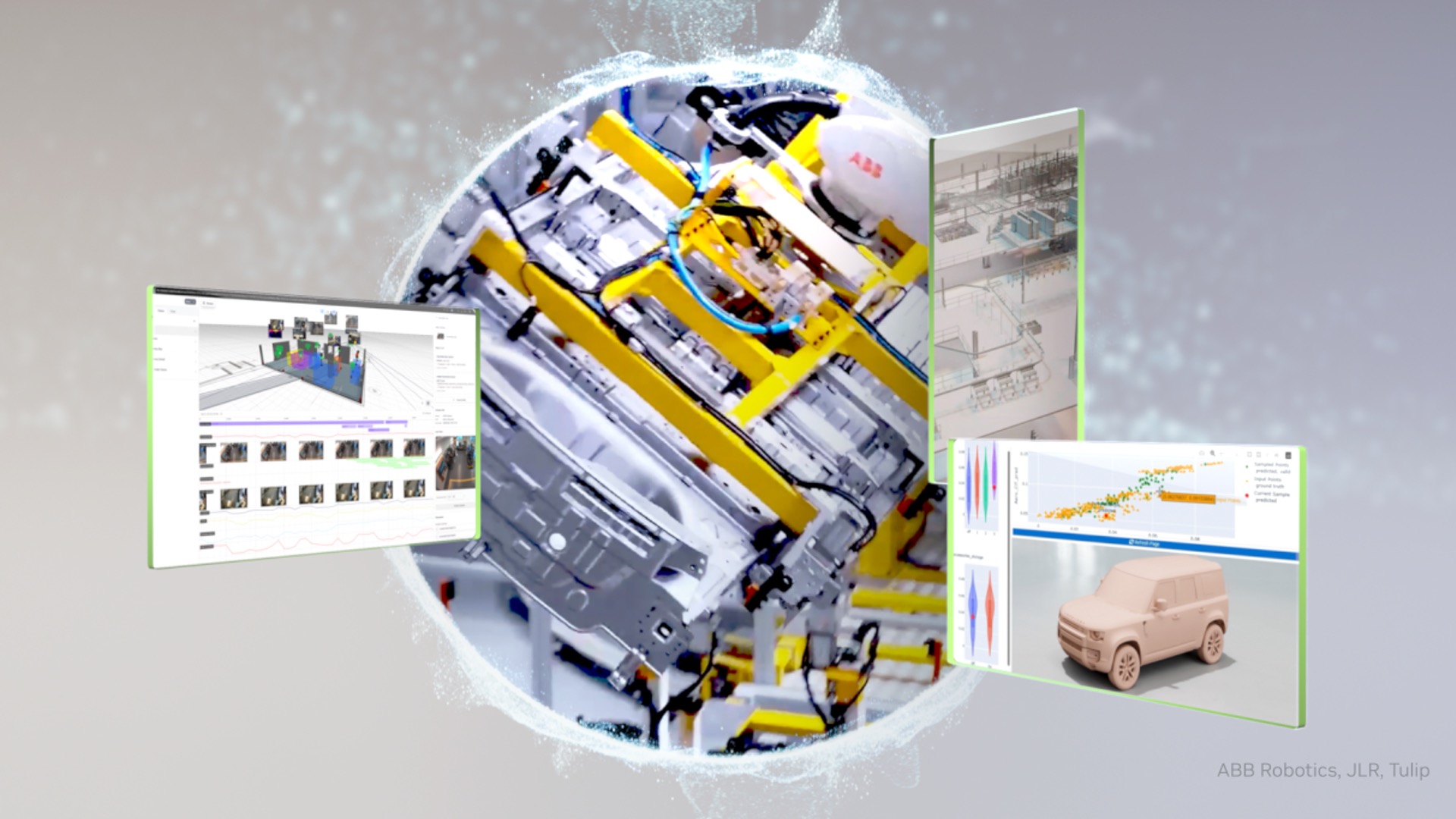
Today, high-fidelity simulation has matured to the point where synthetic data can train production-grade AI systems with remarkable accuracy. Manufacturers are now creating digital twins — virtual replicas of factories, robots, and products — that behave with near-perfect physics. This shift enables perception systems, reasoning models, and autonomous workflows to be validated in simulation before a single physical part is ever made.
OpenUSD and SimReady: The Standards That Make It Possible
One of the biggest hurdles in simulation-first manufacturing has been the lack of interoperability between 3D tools. Assets created in computer-aided design (CAD) software often lose physics properties, geometry, and metadata when moved to simulation or AI training platforms. This forces engineers to reconstruct assets from scratch — a time-consuming and error-prone process.
OpenUSD (Universal Scene Description) has emerged as the connective standard that solves this fragmentation. Originally developed by Pixar for film, USD is now being adopted across industrial pipelines as a universal interchange format. On top of that, SimReady — a content standard built on OpenUSD — defines exactly what a physically accurate 3D asset must contain to work reliably across rendering, simulation, and AI training.
NVIDIA's Omniverse platform provides the physics-accurate, photorealistic simulation layer where AI models are trained and validated before deployment. By combining OpenUSD, SimReady, and Omniverse, manufacturers can finally achieve a seamless, simulation-first workflow.
Real-World Implementations: How Leading Manufacturers Are Using the Stack
ABB Robotics Closes the Sim-to-Real Gap at 99% Accuracy
ABB Robotics has integrated NVIDIA Omniverse libraries into its RobotStudio HyperReality platform, a simulation environment used by more than 60,000 engineers worldwide. In this system, robot stations are represented as USD files running the same firmware as their physical counterparts. This allows engineers to train robots, test part tolerances, and validate AI models before the production line even exists.
A key advantage is the ability to generate synthetic training variations at scale — including changes in lighting conditions, geometry differences, and other edge cases that would be impractical to replicate manually. The result is a simulated environment that transfers flawlessly to the real world.
“We’ve managed to vertically integrate the complete technology stack and optimize it to a point where we’re now achieving 99% accuracy on the simulated version,” said Craig McDonnell, managing director of business line industries at ABB Robotics.
The downstream benefits are substantial:
- Up to 50% reduction in product introduction cycles
- Up to 80% reduction in commissioning time
- 30-40% reduction in total equipment lifecycle cost
These numbers demonstrate that simulation-first isn't just a theoretical advantage — it delivers measurable operational improvements.
JLR Compresses Four Hours of Aerodynamic Simulation to One Minute
JLR (Jaguar Land Rover) applied the same simulation-first principle to vehicle aerodynamics. The traditional process of running computational fluid dynamics (CFD) simulations for aerodynamic drag and cooling could take hours per design iteration. To accelerate this, JLR trained neural surrogate models on more than 20,000 wind-tunnel-correlated CFD simulations across their vehicle portfolio.
The result: what once required four hours of simulation time is now compressed into under one minute. Over 95% of JLR's aero-thermal workloads now run on NVIDIA GPUs, allowing engineers to explore thousands of design variations virtually — confident that the simulation results match physical wind-tunnel data. This speed increase enables more aerodynamic, energy-efficient vehicles to reach production faster.
Conclusion: The Future Is Simulated
The manufacturing industry is entering a new era where simulation is the primary environment for design, testing, and validation. Standards like OpenUSD and SimReady ensure that digital assets are consistent and accurate across all tools, while powerful simulation platforms like NVIDIA Omniverse provide the fidelity needed for production-grade AI.
As demonstrated by ABB Robotics and JLR, the benefits are clear: faster time-to-market, lower costs, and higher quality products. The build-first mindset is giving way to a simulation-first approach — and the factories of the future will be designed, tested, and optimized in the digital world before a single weld is made in the physical one.