Breaking Free from the Forking Trap: Meta’s Journey to Modernize WebRTC
Introduction
At Meta, real-time communication (RTC) powers a vast array of services—from Messenger and Instagram video calls to low-latency cloud gaming and VR casting on Meta Quest. To meet the performance needs of billions of users, Meta has long relied on a specialized, high-performance variant of the open-source WebRTC library. However, maintaining a permanent fork of such a large open-source project comes with a well-known risk: the forking trap. Over time, an internal fork can drift away from upstream developments, cutting itself off from community improvements, bug fixes, and security patches.
Recently, Meta completed a multiyear migration that broke this cycle. They successfully moved over 50 use cases from a divergent WebRTC fork to a modular architecture built on top of the latest upstream version. This article explores how they engineered this solution—including a dual-stack architecture for safe A/B testing, workflows for continuous upgrades, and the resulting benefits in performance, binary size, and security.
The Challenge: Monorepo Constraints and Static Linking
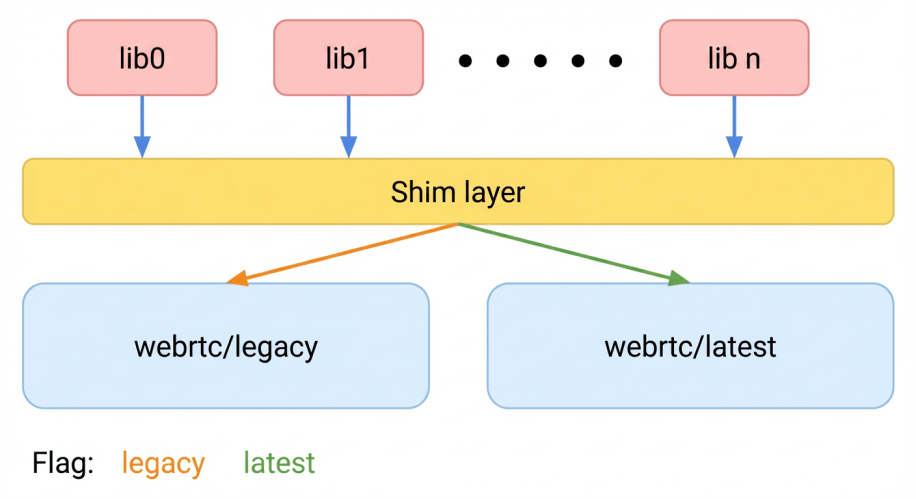
Upgrading a critical library like WebRTC is always risky when serving billions of users across diverse devices and environments. A one-time upgrade could introduce regressions that are hard to roll back, potentially breaking user experiences. To mitigate this, Meta prioritized A/B testing capabilities, allowing the legacy version of WebRTC to run side-by-side with a new upstream version (with clean patches) in the same application. The goal was to dynamically switch users between the two versions to verify the new one without disruption.
However, Meta operates within a monorepo—a single repository containing all its code. The build graph and binary size constraints made it necessary to statically link both WebRTC versions. Unfortunately, C++’s One Definition Rule (ODR) is violated when two versions of the same library are linked together, causing thousands of symbol collisions. The solution required finding a way to make two versions coexist in the same address space without conflict.
A Modular Architecture: Breaking the Fork
Coexistence Through Symbol Hiding and Dual-Stacks
To bypass the ODR issue, Meta engineers developed a technique that effectively hid one version’s symbols from the other. They wrapped the new upstream WebRTC build in a static library with all symbols marked as internal, and then linked it into a separate dynamic library (a shared object). This dynamic library was loaded at runtime alongside the main application, which still contained the legacy fork. By using dynamic loading and careful interposition, the two versions could operate without symbol clashes.
This setup allowed Meta to create a dual-stack architecture where both the old fork and the new upstream version were compiled into the same application binary. The app could then A/B test users by switching between the two stacks. This was a key enabler for safe, gradual upgrades.
Enabling Continuous Upgrades
Once the dual-stack architecture was in place, Meta could roll out each new upstream WebRTC release incrementally. They developed automated workflows that:
- Ported Meta’s proprietary features (e.g., custom codecs, network optimizations) as clean patches on top of the latest upstream commit.
- Built both the legacy fork and the new upstream version with these patches using the modular approach.
- Ran large-scale A/B experiments to measure performance, stability, and user experience across the 50+ use cases.
- Gradually migrated each use case from the fork to the new upstream version once the experiments confirmed it was safe.
This continuous upgrade cycle meant Meta no longer fell behind the community. Each new upstream release could be quickly evaluated and adopted, reducing the risk of major architectural drift.
Results: Performance, Size, and Security Gains
The migration yielded significant improvements:
- Performance: The new upstream WebRTC version included optimizations from the open-source community, leading to lower latency and better call quality across devices.
- Binary Size: By moving to a modular architecture and applying patches only where needed, Meta reduced the overall size of the RTC library compared to the monolithic fork, which had accumulated years of custom code.
- Security: Regularly updating to the latest upstream release meant Meta could quickly incorporate security patches and vulnerability fixes, closing gaps that had existed in the older fork.
Moreover, the A/B testing framework gave teams confidence to upgrade frequently. They could roll back instantly if regressions appeared, making the process far less risky.
Conclusion
Meta’s approach to escaping the forking trap is a powerful example of how to manage large open-source dependencies at scale. By building a dual-stack architecture that allowed two WebRTC versions to coexist, they broke free from the cycle of divergence and enabled continuous, safe upgrades. Today, they continue to use this workflow to A/B test each new upstream release before rolling it out across their vast ecosystem of real-time communication services. The lessons learned here can benefit any organization struggling with the maintenance burden of internally forked open-source projects.