International ETFs Compared: IXUS vs VYMI for Global Diversification
Introduction
Investors looking to spread their holdings beyond U.S. borders often turn to international stock ETFs. These funds offer exposure to foreign markets, which can reduce portfolio risk and tap into growth opportunities elsewhere. With the global artificial intelligence boom benefiting companies worldwide and some economies growing faster than America’s, international diversification is more relevant than ever. But not all international ETFs are alike. Two popular options—iShares Core MSCI Total International Stock ETF (IXUS) and Vanguard International High Dividend Yield ETF (VYMI)—serve different purposes. This article compares their strategies, costs, and potential roles in a portfolio.

IXUS: Broad International Exposure
The iShares Core MSCI Total International Stock ETF (NASDAQ: IXUS) aims to mirror the performance of the MSCI ACWI ex USA Investable Market Index. This index captures large-, mid-, and small-cap companies from developed and emerging markets outside the United States. As a result, IXUS provides a comprehensive view of international stocks, offering investors a single-ticket entry into global markets.
Key Features of IXUS
- Diversification: IXUS holds over 4,000 stocks from more than 20 countries, spanning sectors like technology, healthcare, finance, and consumer goods. This broad base reduces the impact of any single company or country.
- Low Cost: With an expense ratio of just 0.07%, IXUS is one of the most affordable international ETFs available. Low fees mean more of your returns stay in your pocket.
- Rebalancing: The fund automatically adjusts its holdings to track the underlying index, making it a passive, low-maintenance investment.
- Dividend Yield: While not focused on high dividends, IXUS offers a modest yield, typically around 2-3%, distributed quarterly.
VYMI: Income-Focused International Investing
The Vanguard International High Dividend Yield ETF (NYSEARCA: VYMI) takes a different approach. It tracks the FTSE All World ex US High Dividend Yield Index, which selects stocks from developed and emerging markets outside the U.S. that have above-average dividend yields. This fund is designed for investors seeking regular income from international equities.
Key Features of VYMI
- Income Focus: VYMI targets high-dividend-paying companies, resulting in a yield typically around 4-5%. Dividends are paid quarterly, providing a steady income stream.
- Concentrated Holdings: The fund holds about 400-500 stocks, focusing on sectors like financials, energy, and consumer staples—industries known for generous dividends.
- Expense Ratio: At 0.22%, VYMI is more expensive than IXUS but still reasonable for a specialized ETF.
- Geographic Spread: Like IXUS, VYMI invests across multiple countries, but its selection criteria mean it may overweight certain regions, such as Europe and Asia-Pacific.
IXUS vs VYMI: A Side-by-Side Comparison
Both ETFs provide international diversification, but they cater to different investor goals. Below is a comparison of their key attributes.
| Attribute | IXUS | VYMI |
|---|---|---|
| Focus | Broad market index | High dividend yield |
| Number of Holdings | Over 4,000 | ~400–500 |
| Expense Ratio | 0.07% | 0.22% |
| Dividend Yield | ~2–3% | ~4–5% |
| Ideal For | Growth-oriented diversification | Income-seeking investors |
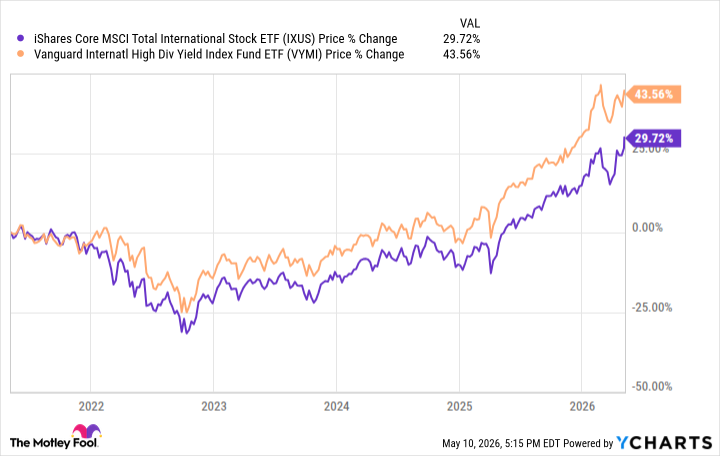
If your priority is low-cost, broad exposure to international markets, IXUS is a strong choice. Its vast holdings minimize company and country risk, and its meager fee leaves more room for capital appreciation. On the other hand, if you need income from international stocks and are comfortable with a more concentrated portfolio, VYMI’s higher yield can be appealing. However, VYMI may underperform in growth-driven markets because high-dividend stocks sometimes lag behind during bull runs.
Conclusion: Which ETF Should You Choose?
The decision between IXUS and VYMI hinges on your investment objectives. For a core international holding that provides broad diversification at minimal cost, IXUS is hard to beat. It is suitable for long-term growth and can be combined with domestic ETFs for a balanced portfolio. Conversely, if you are in retirement or need regular cash flow, VYMI’s focus on dividends can supplement your income without giving up international exposure.
Many investors choose to include both: use IXUS for general international exposure and add VYMI to tilt toward dividends. Whichever path you take, remember that international ETFs like these are tools to reduce concentration risk—linking your portfolio’s fate to global economic trends rather than just one country. Consider your time horizon, risk tolerance, and income needs before making a decision.