How to Migrate a Hyperscale Data Ingestion System: A Step-by-Step Guide
Introduction
Migrating a large-scale data ingestion system—like the one powering Meta's social graph—presents a unique set of challenges. The move from customer-owned pipelines to a self-managed data warehouse service required careful planning, rigorous validation, and robust controls. This guide walks you through the proven strategies and solutions that enabled a seamless migration of thousands of jobs across petabytes of data. Whether you're modernizing your own data infrastructure or planning a complex system overhaul, these steps will help you ensure data integrity, maintain performance, and deprecate legacy systems without disruption.

What You Need
- Existing data ingestion system (e.g., legacy MySQL-based pipelines)
- Target new architecture (e.g., self-managed data warehouse service)
- Monitoring and logging tools for latency, resource usage, and data quality
- Automated verification scripts for row count and checksum comparison
- Rollback automation to revert jobs quickly if issues arise
- Dedicated migration team with expertise in data engineering and operations
- Communication plan for stakeholders and downstream users
Step-by-Step Migration Process
Step 1: Assess the Current System and Define Clear Goals
Before any migration begins, thoroughly understand your legacy system's limitations. At Meta, the legacy ingestion system exhibited instability under strict data landing time requirements as scale grew. Define what success looks like: improved reliability, no data quality issues, no latency regressions, and the ability to handle future growth. Engage upstream data sources (like MySQL shards) and downstream consumers (analytics, ML, reporting) to align expectations.
Step 2: Design a Migration Lifecycle with Verification Gates
Create a structured lifecycle that every job must pass through. The lifecycle ensures data integrity and operational reliability before promotion. At Meta, each job went through these verification gates before moving to the next phase:
- Data quality check: Compare row counts and checksums between old and new systems to ensure complete consistency.
- Landing latency check: Verify that the new system delivers data as fast as (or faster than) the old system.
- Resource utilization check: Ensure no unexpected resource regressions (e.g., CPU, memory, I/O).
Document these criteria and automate their execution to speed up the migration while maintaining rigor.
Step 3: Implement Robust Rollout and Rollback Controls
For large-scale migrations, you must be able to roll out changes gradually and roll back instantly if problems occur. Establish mechanisms such as feature flags, canary deployments, or shadow runs. At Meta, job-level controls allowed engineers to migrate a subset of jobs first, monitor their behavior, and then expand. A rollback plan should be pre-built for every job, with automatic triggers if key metrics deviate from thresholds.
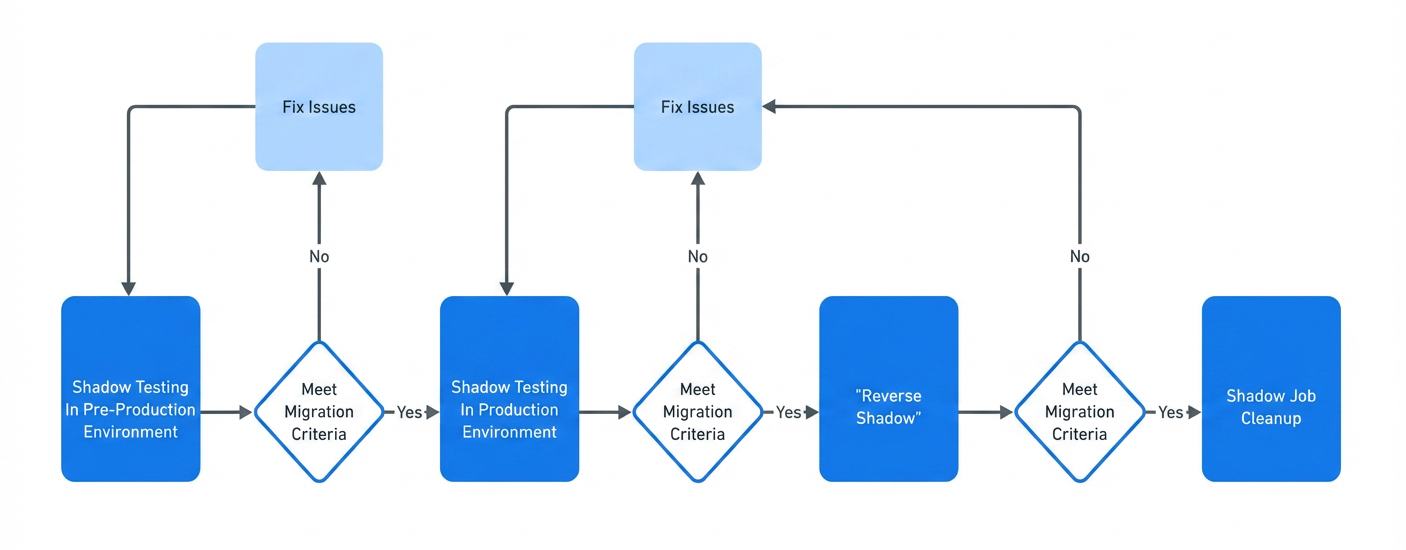
Step 4: Migrate Jobs Using Shadow Runs and Parallel Comparison
Set up shadow runs where the new system processes data alongside the legacy system, but only the legacy system's output is used downstream initially. This allows you to validate correctness without risk. Continuously compare outputs using automated scripts—especially row counts and checksums. Pay attention to edge cases (e.g., late-arriving data, schema changes). Once a job passes all verification gates for a sustained period, it can be promoted to production use.
Step 5: Validate Performance Metrics Continuously
After promotion, keep monitoring the job's landing latency and resource usage. At Meta, they required that new system performance match or exceed the old system. Use dashboards and alerts to track any drifts. If a regression is detected, the system should automatically revert to the legacy pipeline (if still available) and alert the team. Over time, as confidence builds, you can deprecate the old pipeline for that job.
Step 6: Track Migration Progress and Escalate Issues
Maintain a central dashboard showing the migration status of every job—whether it's in shadow, validated, promoted, or fully migrated. This helps identify bottlenecks and prioritize remaining work. At Meta, a dedicated team tracked the lifecycle and ensured that downstream consumers were aware of any changes. Regular syncs with stakeholders prevented surprises.
Step 7: Deprecate the Legacy System
Only after 100% of the workload has been successfully migrated and verified should you shut down the legacy system. At Meta, they deprecated customer-owned pipelines entirely. Before decommissioning, run a final global validation to ensure no residual dependencies exist. Archive configuration and logs for post-migration analysis.
Tips for a Successful Hyperscale Migration
- Automate as much as possible: Manual verification doesn't scale. Use scripts and monitoring tools to compare data and detect anomalies.
- Start small, then expand: Migrate a handful of low-risk jobs first to test your lifecycle and controls.
- Communicate early and often: Keep downstream teams informed about migration timelines and any expected changes in data delivery.
- Plan for the worst: Always have a rollback strategy for each job. Document failure scenarios and recovery procedures.
- Invest in observability: Without detailed metrics on latency, resource usage, and data quality, you cannot validate success.
- Don't rush: A phased migration over weeks or months reduces risk and allows time to fix issues.
- Learn from each job: Use post-migration reviews to refine your process for subsequent batches.
By following these steps, you can replicate Meta's success in migrating a hyperscale data ingestion system—ensuring data integrity, operational reliability, and a seamless transition for all users.